In this digital world, the attention span of people is decreasing day by day. They don’t like to wait for what they want. 40% of people leave a site if it takes more than 3 seconds to load.
Obviously, people don’t wait and sit for several seconds to load a web page.
Let me explain it to you. If a user clicks through your webpage and it takes few seconds to load your page, the chances are that they’ll leave your page.
Fortunately, if you identify the reasons behind slow lead times, there’s a way to increase your page speed.
Google PageSpeed Insights gives you a first set called field data. This includes various aspects of your website.
1. First Contentful Paint (FCP)
First contentful paint or FCP is when your browser displays the information, such as images (including background images), text, scalable vector graphics, and non-white canvas.
2. First Input Delay (FID)
It measures the response time of the site when a user first lands on it. For instance, if your user clicks to play a video, the time video takes is called FID.
3. Largest Contentful Paint (LCP)
Largest contentful paintis a Google metric to measures the time it takes for the largest content on the page to load. LCP is used as a ranking factor for pages by Google
4. Cumulative Layout Shift (CLS)
Cumulative Layout Shift (CLS) is also a Google ranking factor. It’s an indication of improper coding and can be caused by ads, images, contact forms, videos, and fonts.
Using Lab Data to Increase Page Speed
The second set of elements is called lab data. It includes the elements above and total blocking time, time to interactive, and speed index.
1. Speed Index (SI)
The average time for all elements on a page to become visible is called speed index or SI. It is measured in milliseconds, and it calculates the time for images or videos to load.
2. Time to Interactive (TTI)
Time to Interactive or TTI is how much time it takes for the interactive elements on a page to load.
3. Total Blocking Time (TBT)
TBT measures the time between time to first contentful paint and the time a site becomes interactive.
Why should you Improve Page Speed?
User experience is affected by the page load speed; it can either make or break your website.
Faster page loading speed results in a better user experience and can grow page conversions & views while reduces bounce rate.
Eight Ways to Increase Your Page Speed
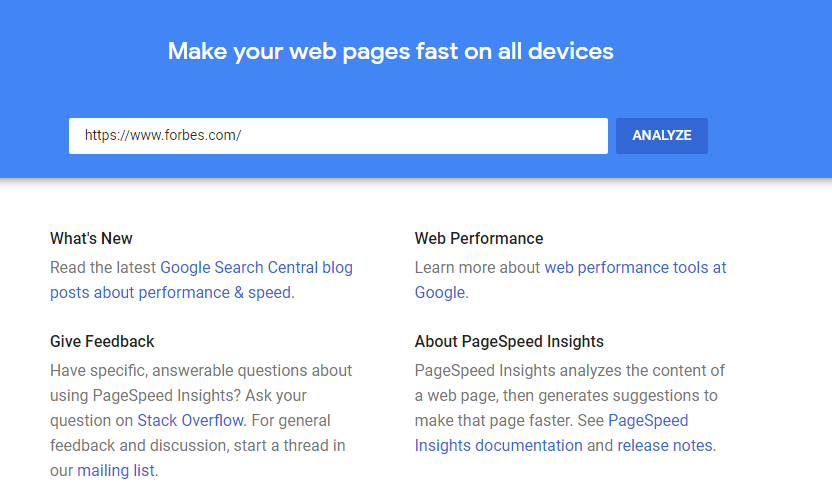
Go to Google PageSpeed Insights and check the speed of your website, as shown below.
It has a bar to enter a URL, and then it’ll take 1-2 minutes to analyze and check your website.
Now you’ll get a score like this.
This red sign shows a low score; these factors affect the final score,
antivirus software
Conducting A/B tests
testing on different devices.
Ads changing on your page
internet traffic routing changes
browser extensions that inject JavaScript.
Following actions can also increase your page speed:
Resize and Optimize Images
Large or too many images can slow down your page load time. Make sure to compress your images and resize them.
The right format which is being supported by all the browsers is PNG and JPEG. So make sure to use these formats because they’re easily compressed.
Compressing means reducing the size of the image file and is represented in KBs and MBs.
Never use an image larger than 1 MB, and if you’re using high-quality images, they can be 60-80% resized.
Trailing Slash
A forward slash placed at the end of a URL is called a trailing slash. Don’t forget to add it.
The more redirects you have, the longer it takes the server to find and load the correct page. Eliminate all the unnecessary redirects because more redirects mean the server will take more time to find and load the required page
4. Use a CDN
With a content delivery network, a network of different servers hosts your site locally to increase page load times. A user in Los Angeles accessing a website hosted in Toronto, for example, wouldn’t have to ping the server of origin but rather a closer one in Los Angeles.
When you spread out the content on multiple servers, it lowers the number of requests to the server of origin, which slows down page load times.
5. Limit Plugins
JavaScript, extra elements, and plugins increase your page load time. I
However, some plugins help to improve your site speed. For example,
Plugins that resize images automatically,
Minify code & defer JavaScript loading can help with page speed.
6. Minify Your HTML or CSS
Codes minification, you take out all the notes, spaces, and extra markup developers use to make their code readable and easier to work on down the road.
A server doesn’t need all that to read JavaScript, HTML, or CSS, and it can get in the way when it tries to load a page.
These tools can help you minify your websites:
For JavaScipt: Google Closure Compiler
For CSS: YUI Compressor from Yahoo
For HTML: HTMLMinifier
For CSS: Microsoft Ajax Minifier
7. Utilize Caching
If a site caches, the server saves copies of its web pages. So the site doesn’t have to start again every time it loads. You can reduce time by using caching.
8. Web Host Selection
For Web hosting, you get what you’ve paid.
Some low-cost packages cannot handle as much traffic, which automatically slows down the speed of your page.
Following are the 4 kinds of web hosting services you can choose from:
Shared Hosting: It has a low cost and can slow down your site. In shared hosting, a single server hosts multiple small sites.
VPS Hosting: A virtual private server, or VPS, hosts many sites, but each site has a virtual “spot” dedicated only to them. Because it’s virtual, it gives you more resources, potentially reducing the risk of site speed issues related to traffic.
Dedicated Server Hosting: It’s an expensive server, but it doesn’t slow down the speed once you have more traffic. In a dedicated server, 1 site is hosted on a single server.
Cloud Hosting: Websites are hosted on a network of physical and virtual servers that offer more flexibility & resources. For instance, If you suddenly get a boost in traffic, a virtual host will handle it.
To choose the best hosting service for your website, consider your budget and the sizes of your sit.
Now, let’s take a detailed look at the benefits of page speed.
1. User Experience
According to our research, 47% of consumers expect to load a webpage in less than 2 seconds.
Your audience doesn’t wait for your page to load and often bounce to find another website with a better user experience.
2. Page Views
You might have noticed that your page loads faster, the better views and ranking you may have on Google.
3. Conversions
If your pages load quickly, it will result in more conversions.
4. Bounce Rate
A report shows that if your page load time increases from 1-3 seconds, the bounce rate also increases by 32%.
Bottom Line
For a better user experience, the fast loading of a webpage is an essential component.
Also, for Google’s ranking algorithm and page views, loading speed has become vital.
First of all, you need to identify the common issues to improve your page speed. These issues can be large-sized images, or you’re using too many plugins.
Have you checked your site speed by Google’s PageSpeed Insights? Please share your common issues.
Colors have an important effect on emotions and behaviors.
When our eyes see colors, they communicate with under surface part of the brain called the hypothalamus, which sends signals to the pituitary gland and thyroid glands. The thyroid glands then release hormones, which affect our emotions, mood, and attitude.
The interesting fact is that color influences 85% of buyers’ purchase decisions. A case study shows that adjusting colors can increase conversion by 24%.
This study is called color psychology. Now, if you use the right colors, you will surely win.
Color Psychology
Color psychology is the study of colors in human behavior. It is related to behavioral psychology.
In a journal article on color, Satyendra Singh says that it only takes one and a half minutes for a customer to form an opinion about a product. And, 60-90% is affected by the color of that product.
It determines how color affects our buying decisions.
Does the color of a t-shirt compel us into a purchase?
Does the color of a button and icon make us click on it? The answer is “yes, it does.” But the “why does it happen” part is a bit more complex.
Color psychology is a must-study field for marketers, leaders, office managers, gardeners, brand designers, architects, chefs, product designers, packaging persons, store owners, and even schools while painting the classrooms for the new admissions!
In short, our product’s success depends upon our use of the color scheme.
However, the psychology of color is a controversial topic in website designing and marketing because the choice of color varies between individuals.
For instance, many people prefer blue to red, while even twins might pick different dress colors.
Use of Color Psychology
Colors impact up to 90% of an initial impression. It doesn’t matter if you’re developing software, designing a book cover, website, or simply branding your products.
In this article, I’ll discuss the use of color in website design, such as a website’s color scheme (graphics, headlines, backgrounds, borders, popups, and Icons.
This article covers the tips which can be applied to a wide range of areas, such as:
Websites
Logos
Videos
Menu bars
Landing pages
Email marketing
Branding
Social media posts
Cover photos
Product design
Proper Way to Use the Color Psychology
Use of color is a sensitive thing. You have to use it in the proper way, at the right time, with the target audience, and for the right purpose.
For instance, if you are selling princess castles, you don’t need to use a dark color website.
To sell princess castles and bouncers, you’ll have to use bright and vibrant colors, probably some pink, red, blue, greens, and maybe a splash of yellow or orange.
On the flip side, if you’re selling bangles to women, you don’t want to use brighter colors. Maybe that’s why Hermes uses light colors and white in their e-commerce background.
If you want to succeed at using color psychology, follows these four principles:
The right audience
The right way
The right purpose
The right time
Here are some color psychology tips to improve conversion.
Color Psychology Tips to Drive Conversions
Conversion rate optimization is the basis of building a successful website. The goal is to get the best return on investment and thrive, no matter who your competitors might be.
Following are a few color psychology tips to keep in mind.
1. Women preference of colors
There are sociological differences between color preferences.
Color and gender survey report reveals that 35% of women picked blue as their favorite color, 23% chose purple, and 14% green.
In the least favorite color, 33% of women confessed that orange and brown are their least favorite colors, while 17% don’t like gray.
It is a common misconception that pink is the universally loved female color. But, It’s not.
Pink may suggest femininity in color, but a tiny percentage of women like pink color.
If your e-commerce website uses colors other than pink, like blue, green, and purple, you may attract more female visitors. This results in improved conversions.
2. Men Preference of colors
If you’re selling to men, then the color choice might be different: blue, black, and Green, while staying away from purple, brown, and orange.
Blue, black and green is traditionally associated with maleness.
But these gender preferences are not the final color theory.
Gender is a slightly complex topic, and not all women or men will prefer/avoid the colors above.
3. Blue color
Blue is one of the most used and powerful colors for promoting reliability, peace, loyalty, and tranquility.
This color is often associated with the water and sky. It creates a sense of peace, order, and security.
Companies choose the blue color in marketing to build trust in their products.
Due to its psychological effects, you can use this color on landing pages.
The world’s biggest social network, Facebook, is blue.
A billion-dollar company, PayPal, also chooses the blue color.
If they were to try red or yellow as the theme color, they probably wouldn’t have the conversions.
Although blue is a great color, you shouldn’t use it in anything related to food.
Do you know why? Because people who’re on a diet use blue plates to overcome their eating habits.
4. Yellow Color
Yellow color is associated with warning. Hence, the yellow color is used for warnings, wet floor signs, and traffic signals.
According to some color psychologists, yellow is the color of happiness.
People associate yellow with the sun, and it evokes positive energy and creativity. Business Insider claims that using yellow in brands shows the fun and friendly side.
While yellow is considered a cheerful color, people are more likely to become angry in yellow rooms, making babiescry more in yellow rooms.
It can also cause nausea, though there are no shreds of evidence for these claims.
Do not use yellow color unless you want to cause anxiety in your audience.
5. Green Color
Perhaps the most soothing color connection is green; it is associated with nature and the environment. It’s associated with power, health, tranquility, creativity, and passion. Companies use green color to promote eco-friendly products or bio-production. This color evokes harmony and peace.
If your website focuses on nature, natural/organic products, and the environment, Green is an ideal color choice.
Green isn’t just about the environment and nature, though. Green is considered a good call to action color when used with the isolation effect or von Restorff effect. For example, the Statue of Liberty in New York is big, tall, and green.
Orange color is associated with fun, competition, and confidence. It is used heavily by children’s product companies and sports teams.
Amazon.com uses orange color in the banners of “limited time offer.” It is actionable and suggests urgency.
It also uses orange in call-to-action icons, such as buy now, add to cart, and coupons.
The successful brand logo, Symantec, has a black and orange checkmark for its logo.
On the flip side, stats show 26% of people associate it with cheap products.
7. Black
Black color in many cultures, black symbolizes death, evil, and dark powers. But psychology associates it with elegance, power, sophistication, and tradition.
For example, Louis Vuitton uses black color in their site.
42% of customers consider black products as a high-quality item. Lamborghini also uses black color.
8. White color
In color psychology, white is the color of purity, simplicity, and safety.
It also symbolizes cleanliness, intelligence, and professionalism.
That’s why scientists and doctors wear white. To show creativity and a new beginning, companies use. For instance, the most popular search engine site in the world is all white.
Bottom Line
Color psychology has a huge impact on people and plays a significant role in conversions.
Different colors are associated with different cultures, so adapt your color choice as per your target audience.
You can accomplish your goals by using colors correctly,
At the right time,
With the right audience
For the right purpose.
People buy your products from the prism of your colors. Each color evokes different emotions.
Hopefully, you’ll decide your right color through the palette. But, if you’re not sure about your color selection when building a website, then make few samples to go for the best.
Have you observed a color change effect on your conversions?
The hreflang attribute (also referred to as rel="alternate" hreflang="x") tells Google which language you are using on a specific page, so the search engine can serve that result to users searching in that language.
Code Sample
link rel="alternate" href="http://example.com" hreflang="en-us" />
What is Rel=”Alternate” Hreflang=”x”?
Introduced by Google in December 2011, the hreflang attribute allows you to show search engines what the relationship is between web pages in alternate languages. It’s useful when you’ve created content that’s specific to a local audience. The hreflang attribute adds a signal to search engines that a user querying in language “x” will want this result instead of a page with similar content in language “y”.
For example, if you create a Spanish-language version of your English-language homepage, you would tag it as “Español” by using hreflang="es" so that searchers with an IP address that a search engine has reason to believe is in a Spanish-speaking country are served that page in Spanish instead of the English version. This can decrease your bounce rate and increase your conversions by making sure your target audience lands on the version of your page most appropriate for them.
Hreflang can also be used to show that you have content targeted toward variants of a single language. If that’s the case, you can target your pages even more specifically by extending the hreflang attribute with annotations that indicate which region the content is localized for, e.g. Spain hreflang="es-es" versus Mexico hreflang="es-mx". This is particularly useful to geotarget users to control for variations in currency, shipping, seasonality, and culture.
Hreflang is a signal, not a directive. That means that other SEO factors may override the hreflang attribute and cause a different version of your page to rank higher. To give search engines the clearest possible signals about which pages are for users in which language, make sure you’re using other international SEO best practices.
Note that while Google and Yandex currently use the hreflang attribute, Bing uses language meta tags instead.
SEO Best Practices
To get the most benefit out of the hreflang attribute, the following tips are important:
Where the Hreflang Attribute Goes
The hreflang attribute can be placed in the on-page markup, the HTTP header, or the sitemap. Only use one of those locations. If you choose the sitemap, this tool can help you.
What the Hreflang Attribute Looks Like
The hreflang attribute on each page should include a reference to itself as well as to all the pages that serve as alternates for it. If your Spanish website sells Iberian ham to customers in Spain, France, and Portugal only, the hreflang attributes for your homepage might look like this:
The same annotations should appear on your French and Portuguese homepages.
It is still possible that Mexican, French Canadian, and Brazilian customers could see your site (remember, hreflang is a signal not a directive), but if you localize other aspects of your content and site (start by indicating what currency you use and showcasing a local address and phone number), you’re less likely to have to deal with pesky American import/export restrictions on your meat products :).
ISO Language and Region Codes
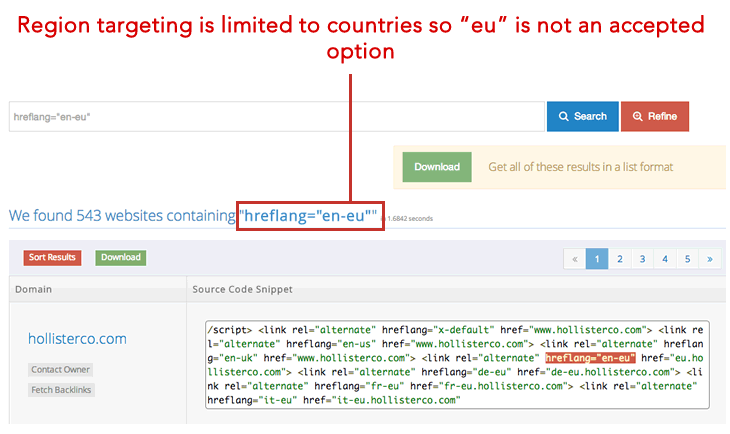
Image from a blog post by Aleyda Solis showing how frequently the wrong hreflang attribute is used.
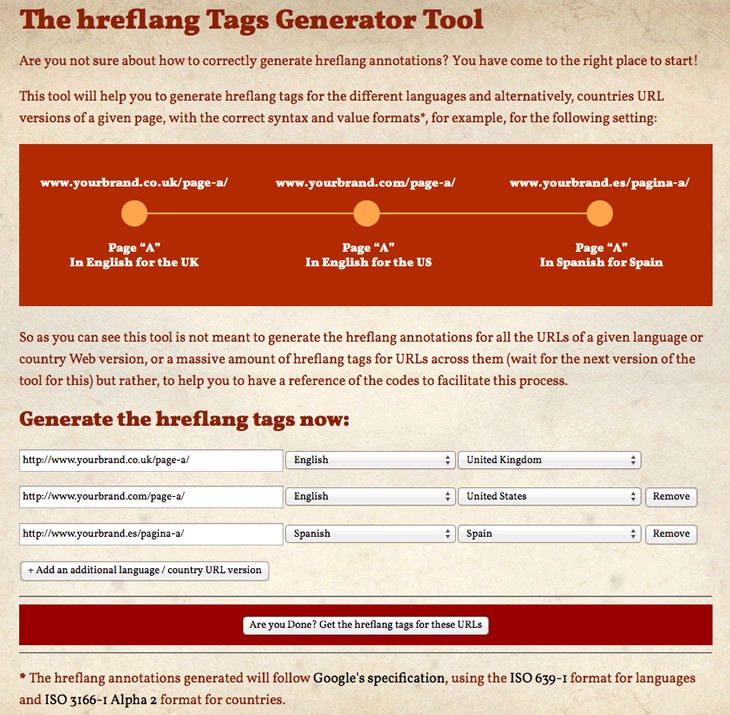
Google supports the ISO 639-1 format for language codes, and you can get more specific by using the ISO 3166-1 Alpha 2 format to signal which region you’re targeting. Not all of the codes are intuitive (for example, the code for the UK is “gb” not “uk”), so double check before pasting the wrong code all over your site. This hreflang tag generator can help.
Image from Aleyda Solis’s blog post announcing the hreflang tag generator.
You can use multiple hreflangs on one page if you want to show that the page is for users in more than one country or area. For example, if the page targets people who speak Amharic in both Ethiopia and Eritrea, you can indicate that like this:
Don’t forget to include a general hreflang attribute without the region code to catch Amharic speaking searchers in Djibouti or other areas of the world that you want traffic from:
If your page serves up content in a variety of languages or just asks a user to select a preferred page, you can use x-default to show that the page is not specifically targeted. That looks like this:
Hreflang attributes may not help you increase traffic; instead, the goal of using them is to serve the right content to the right users. They help search engines swap the correct version of the page into the SERP based on a user’s location and language preferences. For information on how geotargeting can help with rankings, learn about ccTLDs.
The Difference between Hreflang and Canonicalization
Canonicalization is a tool for showing search engines which version of a URL (each with the same content) is the dominant one to avoid duplicate content issues. Hreflang, on the other hand, is a tool to show which of the different (but often similar) pages (based on language or region) should show up in a search.
If there’s one critical thing that can not hurt your business is more sales. But how can you increase your business sales without spending a fortune on marketing strategies and advertising?
Offering discounts can encourage customers to buy more, but they are not feasible in the long run as they may lead to huge losses.
Though you have to spend money to make money, there are instances where you can make money without spending a dime. This blog post will show you clever ways of increasing sales without breaking your bank.
How to Increase The Sales of Your Business
Associate Yourself With the Existing Customers
One of the best ways to grow sales for your business is to link up with your current customers, particularly with the happy, satisfied ones.
These customers already love and value your products or services. But, on the other hand, you have spent your time and resources attracting them. So it makes much sense to get the most of what you have already channeled your energy into.
Please communicate with your customers and try to know them at a personal level where possible. Please get to know their pain points and address them.
You connect with your customers by knowing their:
Shopping patterns
Online habits
Pain points
Income
Demographics like age, sex, location, occupation
Hobbies and interests
Armed to the tooth with this information, you’ll target them with suitable content, marketing platforms, and promotions. But, above all, you will have a simple way of serving them as individuals.
You can discover this data by conducting market research, listening, or reading their feedback on social media platforms and review websites.
Never underestimate the effectiveness of Google Analytics, as it can assist you to know every information you can imagine about your customers and how you can help them.
You know who your customers are by analyzing the available data. Then, when you piece together the information you have collected, you’ll learn how to create personalized connections.
Create a referral system
After connecting deeply with your current customers, use a referral program to tap into their network. Your existing customers are a valuable asset to your business. In addition, they can unknowingly market your business to their circle of friends and families.
You can take things one step higher by creating a referral program. In exchange for a referral, offer a swag item, discount code, or something else of great value.
Experiment with different incentives to discover what works best for you as what works for another business might not work for you.
You may need to test with various referral programs over time to determine what motivates people to aid your business in making meaningful connections.
Establish connections with other businesses
Building relationships with other businesses, whether big or small, could be your answer to increasing sales even when you are operating on a tight budget. This is possible because establishing connections with other businesses helps you generate a considerable following, discover new potential customers, and grow revenue.
Always remember that forming strategic alliances can benefit your business for a lifetime. Also, you can cooperate with other firms to organize fundraisers, events and actively participate in cross-promotions ( using a single product or service to promote another).
For example, suppose your core business is selling bath products online. In that case, you can collaborate with someone who offers massage services at her/ his home to give customers product bundles and spa treatments at discounted prices.
It’s impressive that ninety-one percent of consumers confirmed that positive reviews increase the chances of using the product or services the business offers.
Do you see?
Online reviews could make or break your business.
Also, consider posting on social media regularly or emailing customers to thank them for opportunities to do business with them. Additionally, request them to leave honest online reviews.
You can also offer small future discounts on products or services to encourage customers or clients to recommend you to their close friends, colleagues, and families.
Be sure you read and respond to every feedback you get. According to the survey mentioned above, 71% of consumers are more likely to use a company that genuinely responds to customer reviews.
Always be Thankful to your customers for their feedback and politely and constructively respond to negative feedback.
Create Great Packages, Deals, and Bundles
At times, all you need is a different plan to take your business to the next level. And a superb way to achieve this is to develop clever methods of combining services into one package or several products into a single bundle.
You can pull this off by putting together similar services such as a combo interior or exterior car wash.
Also, you can try various types of services that will enable your customers to enjoy a great deal and at the same time check several things off their main list.
For example, you can offer a free or discounted regular car wash after a customer changes their oil at your premises if you deal in cars. Aspire to give your loyal customers exceptional deals at all the time.
When you offer bundles and packages, customers always cherish the value and convenience of the entire package.
Use Social Media to Promote Your Deals
Of course, not everyone on social media seeks to buy something (particularly with numerous dog videos to watch). Nevertheless, it still can be a superb platform to promote your hot deals.
You can offer some freebies for interested people to grab. For instance, if you run a successful food blog, you can provide free recipes in e-books or PDFs for food enthusiasts to download.
After all, everyone enjoys a good bargain! Giveaways or special offers are more likely to pique your audience’s interest, which will result in increased sales.
You now understand that a call to action (CTA) is necessary for conversions on a landing page or product description.
Also, they’re helpful on your homepage as they govern your visitors’ attention. Consider what you need your visitors on your homepage to do. Do you need them to join your email list? Fill out a form or call you on your phone?
Whatever the correct answer, make it crystal clear on your homepage with a prominent CTA.
Closing Thoughts
All the above tips can help increase your business’s sales, but please do not let the list intimidate you. Instead of trying to
Rather than attempting to execute everything at once, pick one or two areas you need to improve on right away. When you begin getting the results, move on to the next tip and see your sales go up exponentially.
What comes to your mind when you hear the word content marketing? Do you think of what is trending on Twitter, videos that have gone viral on Youtube or Instagram? Is it a blog post that has been shared widely or a Facebook post that has garnered millions of social shares?
If that’s what comes to your mind, then you need to know that content marketing has been with us long before the internet arrived.
It has been around for ages, and mammoth brands globally used it successfully in their formative years. It aided them in breaking through the noise and obtaining their first customers. Also, it enabled them to metamorphose into billion-dollar industries.
A good example is Nike with its well-known tagline- just do it.
It was created more than twenty-five years ago, but it still appears on almost every advert the company runs.
That’s a sizable rate of return on investment. Today the company still uses the symbolic phrase every chance it gets.
Here’s one of their recent images.
Content marketing has been around for a long because it’s about telling stories. And people have told stories ever since they started speaking. People will always pay attention to those who tell great stories.
But what was influential in the 70s and 80s might not work today because so many things have changed since then.
Nonetheless, with many new social media platforms cropping up almost every day, opportunities are endless.
So, let’s see what content marketing means in simple words.
What is Content Marketing?
Content marketing is a tactical marketing procedure that focuses on generating and dispensing relevant, consistent content to attract and retain a specific audience- and eventually, steer fruitful customer action.
Why is content marketing important?
Helps Create Brand Awareness
One of the many reasons some businesses have halted relocating any money to content marketing is that it may be challenging to recognize the benefits of content marketing.
It sounds fantastic to get people to think and talk more highly of your business. Still, you must put your acts together and allocate many hours of your valued time.
However, the results can be phenomenal. Let’s see just how many benefits content marketing can bring to your table.
Creating valuable content gives your target audience something to discuss with you and your brand. When they gladly talk about you, they educate each other about your business, giving your links and recommendations in the process.
They’re marketing your brand unknowingly, and it’s a blessing in disguise on your end. The awareness of your brand they’re creating is marketing gold.
You Get Loads of Admiration and Respect
It’ll take a lot of time to build admiration and respect for your target audience, as you’ll have to earn their trust. And you cannot make anyone’s trust overnight. You have to prove that you are worth your salt.
After proving your integrity and knowledge, you’ll be the guiding light that numerous people will turn to you when it seems as if everybody else is adding to the confusion.
You have to create tons of helpful content and steer clear of those sites that do not care about their readers.
Suppose you create helpful organic content consistently and optimize it well for the search engines. In that case, Google will recognize your site as an authority on a particular topic and reward you by making your site appear high on the SERPs results. So, you get a lot of traffic and improved SEO.
According to this study, content marketing can help your lead generation, enhance your conversion rates and help retain your customers.
Types of Content Marketing
Content marketing definition can be a little bit tricky. But the idea is simple. It’s creating information in different formats that offer value to your target audience and make them buy your service or product.
Consider it like fishing. You don’t jump into the sea or river waters and swim out to start chasing the fish down! No, ordinarily, you use a baiting strategy to draw the fish to you.
In a nutshell, content marketing is an inbound marketing strategy that does a lot of digging to draw customers to you.
It’s more productive than outbound marketing strategies and gives higher rewards in regards to sales and conversions. That said, here are types of content marketing in use today.
Podcast Content Marketing
According to a recent survey ( 2020), 48 percent of 14-to-32-year-olds in the Us had listened to a podcast the month before, with an average of five listening hours per week.
As a result, many businesses and media outlets have begun to create and distribute their podcasts.
Podcasts enable a lot of creativity because they can be about anything. You also decide on other aspects of the podcast, such as the rhythm of episodes and who will appear.
Podcast content Marketing example
Video Content Marketing
Content marketing allows you to showcase your personality and inject some fun into the business world. Videos are an excellent medium for doing so.
You get likable and charismatic people to feature in your video content. Videos are one of the most widely shared and popular on social networks.
Video is also the most popular and widely shared format of content on social media.
Based on Wyzowl research, 69% of customers like learning about a company’s service or product through a short video.
Besides, video marketing increases conversion, boosts ROI assists in building long-term relationships with your followers.
Example of Video Content Marketing
Infographic content Marketing
Infographics present content, data, and information in a visually appealing format. Infographics are a perfect way to easily express the content because they combine easy wording, short sentences, and transparent images. They’re great for simplifying a complicated or educational subject so that everybody in the audience can understand it.
Example of Infographic Content Marketing
Paid Ads Content Marketing
Some clothing and accessories companies utilize sponsored and paid ads to get to their target audience as they scroll through their news feed.
These content ads showcase some of their products or services and details about their return policy and shipping to draw traffic to them and somehow turn them into paying consumers.
Example of a Paid ad on Facebook
Now it’s time to talk about your content marketing strategy. For your content marketing campaigns to be effective, you need to have the right plan in place.
Consider Content marketing strategy as a boy trying to win over a gorgeous girl he has been eyeing for years. He needs to approach her the right way and work his way to her heart.
The best way to win her heart is to start by getting to know her. He should take her out a couple of times and know what she loves, what her values are, what her favorite pet is, and what she likes to eat. He should spend a lot of time with her and there for the girl in every time of need.
The boy needs to behave in a manner acceptable to the woman. That way, he will make himself the one person the girl could lean on, and she’ll win her heart and soul for the rest of her life.
But if he looks at other girls suggestively, entertains other women or causes pointless fights in a club in the girl’s company, his hunt will be over before it begins.
By implementing the right strategy, all your content marketing efforts will successfully convert leads into sales. You’ll also reach your desired audience.
This is the best marketing content marketing advice you’ll ever get. It’s helpful to you regardless of whether you are an experienced blogger with plenty of traffic or a brand-new blogger with a tiny (but lovely) profile. Here are the best marketing strategies you can use right away to succeed in your content marketing efforts.
Best Content Marketing Strategies
Set intelligent, Realistic goals
Setting SMART targets is a critical step in your content marketing plan. These should be tailored to your organization and should support your overall marketing and business objectives.
Your strategy should help you to
Increase customer experience and brand loyalty by building rapport and trust with prospects and consumers.
Find a strategic partner
Boost brand recognition
Increase conversions and eventually increase sales
Decide on What Kind of Content You want to make
The type of content you create largely depends on the people you are trying to reach.
For example, if your target audience’s age is between 14-21 years, you can’t sell them expensive things because they do not have a lot of money to buy.
However, suppose your target audiences are working class and business people. In that case, you can sell expensive products to them as they have money.
Answer the following questions to help you decide who your target audience will be and what type of content would be appropriate for them.
What is the reason they require your product or service?
What can you do to help them succeed?
What do they do with their free time?
What do they need from you?
What obstacles do they hope to overcome?
Select your content channels
After deciding what type of content you want to create, it’s time to choose your unique content marketing channel. Where will your content appear? Or is it on social media platforms, or is it on TVs or magazines? Where to make your content go live depends on your target audience.
For example, if you are in a real estate business targeting pensioners, the best place to place your ads will be in the newspaper, as most pensioners spend a sizable chunk of their time reading newspapers.
But suppose you are a designer targeting teens. In that case, the best place to market your content is on social media platforms such Facebook, Instagram, and Pinterest, as these people hang out on the sites mentioned earlier.
Make your content and distribute it.
Make and distribute your content so that your target audience can consume it and hopefully convert. Always Use a social media calendar to make sure that you are consistently creating content and sharing it with your customers and prospects. It’ll help your team stay on track and also enables you to schedule content creation so that you’ll always have content ready for publishing.
Conclusion
Content marketing is a superb way of drawing traffic to your website. And if you have enough following, you can convert them into paying customers. Remember to get exact value from every content you make. But be careful not to sound to sales.
Now that you understand what content marketing is and the benefits of content marketing, plus some of the content marketing strategies you can use, it’s time you give it a try.
Most small business owners put owning a website on the back burner. Do I Really Need a website? They wonder. They are so used to traditional marketing strategies that they can’t see the need to replace something already working. If this is how you feel, you need to change your thinking.
Consider your website as a digital home for your business. When your company has a digital home, everybody, regardless of their location on the globe, can find your products and services and hopefully buy them hassle-free.
Nowadays, many people carry out a quick Google search before trying new services or products to help inform their purchase. That’s why having a website is crucial for every business that needs to stay ahead of the competition.
However, this is an enormous problem because, according to a Blue Corona study, 80 percent of customers constantly research a business online before stopping by.
So, if you are still sitting on the fence debating whether you need to have a website, this blog post is for you. It’ll give you practical reasons why you need a website.
Here are the Reasons Why You Need A Website For Your Business
Attract new customers
Maybe you are content with the current size of your business, but every firm struggles to get new customers. To promote continued success, you require a reliable way of attracting new customers. And one of the best ways to do this is having an online presence.
Nowadays, people surf the web to find global companies they are dying to do business with and find their local competitors.
To maximize the chances of your customers finding you on the web, you have to optimize your website so that you can rank high on the search engines. That way, your business will grow in leaps and bounds. You won’t even realize it.
Enhances your credibility
Exceptional credibility and reputation are the heart and soul of every business. If people constantly question your credibility, you stand no chance of growing your business.
Years ago, local businesses could advertise themselves by requesting their customers to recommend them to a neighbor. But things have changed now. Small businesses can no longer afford to overlook the significance of having a reliable online presence.
These days, regardless of the size of your business, you require a website.
Otherwise, you risk appearing to be a small operation incapable of providing an excellent service. Having a well-designed website is an easy way to improve your credibility.
Potential clients are becoming more tech-savvy, and most people search the internet first before seeking out a small business. So if you don’t have a website, but your rivals do, potential customers will ask why you don’t.
Your business looks more organized and professional
Your website is also the only excellent place to display any professional certifications or honors your company has earned over time.
Furthermore, creating your website allows you to create a branded email address (chris@yoursite.com). Thus bringing a degree of professionalism to all of your communications, mainly if you’ve previously conducted business using an individual email address.
Having a professional email sets you apart from the crowd. It gives an impression that you do not mind spending on something worthwhile.
It’ll be a challenge for your customers to find you without Online Presence.
When you concentrate on 16-24 year-olds, the number jumps to 97%. They’re not just taking selfies with their tablets, either.
Young people, in particular, now use their phones for banking, shopping, and scheduling appointments. As a result, small companies must think digitally to thrive in the long run.
You must have a website to fairly compete with regional services that are already reaching out to customers via the internet.
Consumers looking for a local service prioritize speed, efficiency, and ease of access. For example, customers are far more likely to book a service if they can quickly fill out an online form instead of speaking with someone directly.
Website helps in attracting more customers than social media platforms
According to a Forrester study, seventy-one percent of consumers begin their purchasing journey with a search engine such as Google or Bing. And 74% utilize search engines during the research part of the consideration stage.
So, currently, we have consumers looking for services and goods at all stages of the buying process. You will not be discovered if you do not have a website.
Even social media-focused companies such as Razor, Buffer, and Social Media Examiner found that search engines drove 5x more traffic to their sites than social media.
This doesn’t necessarily imply that people found brands by using search engines instead of social media. Instead, it insinuates that when people need more information on anything, they are five times more likely to use search engines in place of social media.
Website makes your business available 24/7 for 365 days
Running a small business takes a lot of time. Marketing your services can consume a significant amount of your time and money. Wouldn’t it be better if you could head back to doing what you love? Shouldn’t offering excellent customer service to your valued clients be your number one priority? In this fast-moving digital age, you require a professional website to keep your firm running.
The benefit of owning a website is that your company will always be accessible. Consumers now expect businesses, even tiny local ones, to be reachable online 24 hours a day, seven days a week all year round.
Business hours are no longer valid in most cases because a potential customer can inquire about your products or services at any time.
This constant access to your business can significantly increase your customer base.
It is critical to hire a professional web designer right from the beginning. The web designer should create a responsive and visually appealing website for you.
To remain competitive, your website should be both functional and visually appealing. An informative, well-designed website will cut down on the amount of time you take answering your customer questions.
So, yes you really need a website For your business
The answer is a big fat yes! It is no longer a question of “Do I need a website, it is instead when I’m getting one? In this fast-paced digital era, owning a website is one of the best investments you can ever make for your business. And you’ll reap the benefits even when you are snoring your night away.
Closing Thoughts
If your company has made it this far without a website, you might be thinking, “Do I Really Need a Website?” After all, What’s the point of owning one if my company is still profitable without it? Your site is the digital home for your company that can make money for you even when you are sleeping.
A website provides numerous advantages to small businesses. The majority of these advantages grow in value substantially time after time, much like the internet itself.
New business owners and managers are trying hard to find the secrets of how to improve Google ranking.
No magic button ranks your site within days.
The nature of the Google algorithm is constantly changing, so it takes dedication, resourcefulness, creativity, and persistence.
There are more than 600 million blogsin the world today. 37% of the blogs on the first page get all clicks, while the second-page results get 78%.
So today, let’s take a different approach and think out of the box. Rather than talking about 100+ ranking factors, I’ll list the top ten most useful Google ranking factors.
Backlinks
Backlinks are probably one of the top-ranking factors.
How can we say this?
Backlinks form the basis of
Google’s Gary Illyes confirmed Pagerank is the foundation of Google’s ranking algorithm. And backlinks are the basis of Pagerank.
Research also shows a close relationship between organic traffic and backlinks.
However, backlinks are not created equal.
And 2 main factors contribute to a backlink’s ability to move the needle.
Relevance
Suppose you’re searching for the best burger point in your city and ask 2 friends for a recommendation. One is a vet, and the other is a chef. Whose advice do you consider?
Right!, the chef, as he has experience in fast foods.
On the flip side, if you were searching for cat food recommendations, you would trust the vet.
The same goes for the links from relevant websites and the content value.
Authority
Backlinks from strong sites tend to move the needle most.
A web page and linking domain’s strength can be measures by looking at its Domain Rating and URL Rating in Ahrefs’ Site Explorer:
Content depth
When someone searches for a query, Google wants to rank the most useful results instead of longer or lengthy content.
It’s all about covering all the key information the searcher expects to see.
For instance, let’s search for “best watch brands.”
You can see that the audience’s search intent is “men watches” and “best luxury watches.”
However, we cannot differentiate what’s important content-wise, so let’s check the top-ranking pages.
First, they all uploaded the pictures with a price:
This is a buyer intent strategy because everyone has a budget in mind for a new watch.
Second, they all mention watches from popular brands like Casio and Seiko:
Which actually makes sense!
Thirdly, they all talk about specifications of watches, like thickness and diameter:
So, if you want to rank your site on “best watches,” you should talk about images, prices, brands, and technical specifications.
This isn’t about copying your competitors but looking at the common keywords of top-ranking sites to understand the searcher’s psyche.
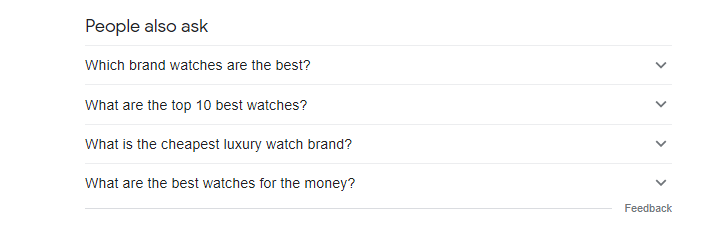
The other important Google factor is by looking at clues of “People also ask” tabs.
Also, look at the bottom of your page to see the “related searches” area.
Content accuracy
Google only ranks accurate content for every query.
Imagine searching “who founded space X,” clicking the search bar, and you’ll find this:
Let’s take another example of “aspirin dosage,” it gets 7,800 searches a month in America.
If Google ranks inaccurate results for this inquiry, it’d be dangerous and life-threatening for the searchers.
So Google makes sure that your information is accurate. How does this happen? Yes, with the help of backlinks.
It makes sense that nobody is going to link to another page that shows inaccurate aspirin dosage.
User intent
Google doesn’t rank the same content for every search.
For instance, I am searching for “buy dresses online”; this shows that I intend to buy the product. So, Google will show eCommerce websites.
On the flip side, if person B is searching for “how to tie a tie.” It means Person B is in learning mode and needs a “how to” and informative content.
Now Google will show the following blog posts.
Let’s understand the concept of 4 Cs.
Content style: It is the dominant style of content, web pages & sometimes videos.
For example, take the query, “Samsung unboxing”:
Content-type: It has four different types: blog posts, category, landing pages, and products.
For example, if you search “buy a smartphone,” top-ranking pages are all eCommerce categories.
Content format: It consists of informational content, such as “How-to article,” listicles, opinions, news articles, and tutorials.
Let’s take an example of “money-saving tips.”
These all are opinion articles.
Content angle: It usually contains a dominant angle in the search results.
For example, all the results of “how to play golf” are for beginners.
Freshness
Freshness is aimed at fresh results and stories.
For example, if you check “Brexit news,” you’ll find fresh and new content. Google ranks a “Top Stories” with results.
This mostly happens in the news because Google knows people want to read recent stories.
On the flip side, if you search for “how to tie a tie,” freshness doesn’t matter because tying steps don’t normally change.
Page speed
Page speed is also a ranking factor since 2010. But in 2018, when Google extended the ranking factor to mobile searches, it changed.
However, it is mostly a problem for pages that loads slowly and have a terrible user experience.
The goal is not about beating your competitors by a few milliseconds. The important point is to make sure that your site is fast enough not to impact users negatively.
How fast it loads?
Google in 2018 said that mobile page content display times for users should be less than three seconds.
However, the total size of a mobile web page should not be over 500kb.
According to John Mueller‘s recent statement, these guidelines are a pinch of salt.
Your website should only be optimization to make the user experience better.
But what does mean by good user experience?
Google has some suggestions for it
Easy-to-read, engaging, valuable, and well-organized content;
Responsive design with no intrusive ads
There are many myths in the SEO community about Google rankings.
But, nobody knows about user satisfaction measures by Google.
So instead of thinking about it, make your site user-friendly, research, organize content, remove distractions, and write for readability.
Bottom Line
In a nutshell, if you want to rank your website in search engines, then give searchers what they’re looking for. And make sure your site has minimal distractions and users enjoy being on your page.
Also, keep these points in mind;
Accurate content with proper explanation
Don’t be a jack of all trades, instead choose your niche
Get backlinks from credible sites
Keep your content fresh and updated
Ranking in Google is not primarily focused on tips and tricks.
It’s all about creating the content for searchers, providing a good user experience, and sending positive signals to Google that it’s the best result for any search.
Let me know if you have any other suggestions to rank the site in search engines?
Create something unique: Write something unique and completely different to stand out in the crowd.
Create something better and valuable: To stand out fast, create your best content that gives value to your audience.
Add a Hook
The best strategy to improve your Google ranking is to get backlinks.
In fact, according to Stone Temple Consulting‘s research, published on the Moz, links play a significant part in Google’s first page rankings. This proves that it’s still a Google ranking factor.
The question is: how can you do it?
It would be best if you analyzed why people in your niche link to specific pieces of content. Then, you can also include that hook in your writing.
Data or stats is just one type of “Hook” that you can use to build links to your site.
Another Hook that’s quite useful right now is Ultimate Guides. So, publish an ultimate guide on your site.
On-Page SEO
Once you are done with research and writing your piece, it’s time to keyword-optimize your SEO content.
It’s not possible to cover On-page SEO in a single post. But let me share three on-page SEO techniques that I recommend applying.
Internal Linking
Yup, it still works if you do it right. Specifically, link from high-authority web pages to your pages that need authority.
Short, Keyword-Rich URLs
After analyzing 11.8 million Google search results, it was found that short URLs rank higher than long URLs.
That’s I suggest you make URLs either just your keywords
Semantic SEO
Semantic SEO means using words that are closely related to your main targeted keywords.
I find words that are related to my target keyword.
Then, I use those terms in my content.
Here are the details,
First, write your keyword into Google Images.
Now Google will give you phrases and words that are closely related to your topic:
Now scroll down to the “Searches related to” and use these keywords in your content.
Optimize for User intent
Google doesn’t rank the same content for every search.
For instance, I am searching for “buy dresses online”; this shows that I intend to buy the product. So, Google will show eCommerce websites.
On the flip side, if person B is searching for “how to tie a tie.” It means Person B is in learning mode and needs a “how to” and informative content.
Now Google will show the following blog posts.
Let’s understand the concept of 4 Cs.
Content style: It is the dominant style of content, web pages & sometimes videos.
For example, take the query, “Samsung unboxing”:
Content-type: It has four different types: blog posts, category, landing pages, and products.
For example, if you search “buy a smartphone,” top-ranking pages are all eCommerce categories.
Content format: It consists of informational content, such as “How-to article,” listicles, opinions, news articles, and tutorials.
Let’s take an example of “money-saving tips.”
These all are opinion articles.
Content angle: It usually contains a dominant angle in the search results.
For example, all the results of “how to play golf” are for beginners.
Catchy Content Design
Content design is one of the most underrated parts of content writing and marketing.
If your content looks like this…
It will never help you to rank.
So, here are four visual content types.
Graphs and Charts: These increase the engagement and credibility of your content. So, try to include at least one chart in every article. Because charts explain complex data, people will sometimes use your charts and link back to your content.
Screenshots and Pictures
If you use LOTS of screenshots in every post, your content will look well-designed. Another plus is to use screenshots to help someone.
Screenshots make sense in technical as well as non-technical niches.
Visualizations and Graphics
Visualizations are kind of like charts, but they visualize concepts, not the data.
Build Website Links
Now let’s actively build links to your content.
There are three link building strategies,
Broken Link Building
Competitor Analysis
Evangelist Method: This strategy is more about getting your content in front of the right audience.
Update Your Content
You could keep producing fresh and new content. But this is a time taking process and a bit complicated.
Instead, you can update your old content in less time and deliver faster results.
This illustration from Moz shows that your original content gradually becomes less and less “fresh,” which affects your website’s quality.
To boost your organic traffic and increase your SEO efforts’ effectiveness, you should update your old content regularly.
When Google detects that your content is new, your website will get a spike in traffic.
Here are the nine reasons to update your old content.
Improve your click-through rate
Fix grammar and spelling mistakes
Improve your content’s accuracy
Include multimedia for better rankings
Optimize for the right keywords
Remove broken links
Share your content & promote it again
Add credible Backlinks
Link to newer resources
Bottom Line
If you focus on these nine SEO strategies, you are boosting your chances of website ranking.
First of all, make a list of keywords. Now analyze the first page of Google and jump to create unique and valuable content. On-Page SEO will also play an important factor in ranking your pages.
Once you optimize user intent, then don’t ignore the catchy design of your content. Link building and updating old content are the most important ranking factors.
Let us know, which SEO strategy have you tried and why?
For many years now people have been going online and browsing the net to locate a dentist close to their home. And if you’re like most other individuals, you may not go further than the first SERP (search engine results page). So, it follows that dentists (and there are thousands of them) whose sites do not figure on the opening results page are overlooked. To put things in perspective a dentist whose website is not effectively optimized for ranking on Google or Yahoo’s first page will lose out. In this guide, you will learn implement seo for dentists to grow your dental practice.
Even in this digital era, countless dentists are completely in the dark about dental marketing. More often than not, dentist marketing entails the different services you provide, how you advertise your practice, and so on. On the other hand, it has to do with your reception’s layout, your practice’s tagline, and how your emblem looks on the website.
Also, most dentists believe that SEO means targeting keywords like “dentists”, “dental treatments”, or similar highly competitive keywords. But it is difficult to rank for those terms and even ranking on them might not give you more clients. Local SEO is something that you need to work for. For example, if you are operating in Tampa Bay, FL, you should consider optimizing your website for keywords like “dentists in Tampa Bay.”
Both tech-savvy and technologically ignorant dentists are gradually realizing the significance of promoting their practice across the online realm. How you design and formulate your dentist marketing and dental SEO strategy will hugely influence your site’s ranking on popular search engines.
Dentist Industry Statistics
In the past five years starting from 2015-2020, the global dental industry has been able to capitalize from a streamlined increase in the number of people having access to public and private dental care. As per ADA’s (American Dental Association) reports, the cumulative costs of dental treatment and care have come down considerably for individuals aged 50-64 years.
Consequently, people bracketed under the above age range have been making more trips to dentists’ chambers and clinics for treatment and preventive care. By taking into account the above trends, it can be safely estimated that the US dental industry’s revenues will burgeon to $128.0 billion which grew at an annual rate of 0.2% from 2015-2020.
In 2018, a dentist in the US earned approximately $175,840 annually on average
Dental/oral diseases and infections affect about 3.5 billion people globally
Europe ranks as the largest amongst all dental implant markets on a worldwide basis
Why SEO for Dentists matter?
As a dentist, you’d surely want to have a flourishing practice attracting as many patients as possible every other day. At the same time, you’d want your site to rank on the search engine’s first results page. But have you chalked out a target-oriented marketing strategy to realize what you desire? Amazingly enough, a significant proportion of dentists and dentistry professionals do not consider dental SEO and dentist marketing a priority for promoting their practice.
Several studies and surveys have indicated that the first five URLs on the first SERP of Google or Yahoo attract nearly 68% of all clicks. So, if your site appears on the first page of search results, you have a good chance of drawing greater online traffic, more potential leads, and finally greater number of patients.
Irrespective of whether you’ve recently started practicing or have a flourishing practice, you’ll need a minimum of 20 new customers (patients) every month to stay in business. The above information has been provided by Aldrich Advisors who prepared a report after conducting a survey on dentists in the US.
The following are some facts and figures about dental SEO and dentist marketing that dentists should keep in mind:
If your site does not rank on the 1st page of Google’s organic results, your chances of attracting 95% of your potential traffic are practically nil
In 2018, Google accounted for nearly 90% of net browsing implying that you’re practically invisible online if you don’t rank on Google’s first SERP
Searching using a relevant keyword leads to an organic click of the first page of search results 71% of the time
78% of prospective customers decide to visit a dentist located close to their homes after conducting a local SEO search on their smartphone
Individuals who locate you (or rather your practice) through organic search have a better likelihood of becoming your patients compared to those who track you using other marketing modes
If your website loads quickly on smartphones (i.e. your site is mobile-friendly) you have a 61% better chance of being contacted compared to outdated dental sites
The topmost marketing priority of 61% of businesses is bolstering their online presence by boosting SEO
Nearly 88% of your existing and prospective customers are more likely to rely on online reviews and feedbacks rather than heed a relative’s or friend’s suggestion
Web-based or online dentist marketing is essential nowadays if you wish to make and/or keep your practice profitable. The overheads associated with your practice including but not limited to staff salaries, equipment cost, and office rental have gradually increased over the years. Given the steep cost of maintaining your practice, making a profit regularly is a tall order.
KPIs for Dental Marketing
You’ll have to periodically review your marketing strategy and analyze your performance as a dentist to stay competitive. Evaluating your dental practice from time to time also enables you to know how you are performing vis-à-vis your competitors. On the other hand, taking stock of your situation and making an overall appraisal gives you a fair idea of the steps you can take to improve your practice.
You can take advantage of KPIs or key performance indicators to carry out a thorough SWOT analysis to understand the strengths and weaknesses of your practice. At the same time, you can exploit KPIs for identifying the threats and opportunities in your practice for sustaining your business. If you want to stay ahead of the competition, just focusing on furnishing quality healthcare may not suffice in this digital age.
You’ll also need to have a good idea of how you can make your practice lucrative and keep it updated. You bet you’ll be able to make the most of the opportunities for progress and take practical data-based decisions by assessing specific KPIs.
Collating and Evaluating the Information Should Be Your First Priority
At the very outset, you’ll have to pool and collate data to realize how you’re faring as a dentist. Chances are that you’re already gathering vital information concerning your practice through your dental practice management software. DPMS (dental practice management software) modules by and large feature built-in standardized reports that enable you to appraise your performance.
You’ll need to spend a substantial amount on business management software designed exclusively for dentist marketing to make optimal use of KPIs. Most DPMS come in handy for producing detailed reports as well as enable you to determine specific metrics appropriate for your practice. A good number of dentists just amass data but do not interpret the information rendering the entire exercise futile.
Some Crucial KPIs that Dental Practices Should Track
Just as you employ an assortment of processes, technologies, and methods for evaluating your patients’ wellbeing there are particular parameters, tools, and principles for analyzing your dental practice’s health. These yardsticks or metrics known as KPIs enable you to identify the drawbacks and lacunas in your practice and also help take measures for improving your business’s health. In the following paragraphs, we will walk you through some of the vital KPIs that dentists can use for performance evaluation. Additionally, we’ll also make you aware of the robust range of such metrics which are standard for profitable dental practices.
The acceptance rate of Treatment Plans/Production Per Appointment or Visit
PPV or PPA (production per visit/production per appointment) is a very crucial metric that dentists can apply for establishing the type and extent of treatment they’re offering. This metric lets you evaluate whether you’re witnessing a decline or an uptick in production. At the same time, you can find out whether this diminishing or enhancement is cyclical or irregular.
The idea behind quantifying or appraising PPA is to find out whether the footfall (of patients) has surged or decreased over a certain period. Patients’ footfall could increase or fall depending upon the quality of treatment you offer. The metric aids you in pinpointing your treatment’s acceptance rate as well as helps you in verifying your performance on the whole concerning your patients.
Periodontal Treatment Rate
Periodontics, the dentistry segment dealing with the structures surrounding and supporting the teeth involves preventative care. As a KPI the periodontal treatment rate assists you in understanding and confirming your overall performance from the perspective of preventative care. You should take note that your performance taken as a whole will have a huge influence on production per visit.
The metric of periodontal treatment rate helps you to find out the answers to several aspects concerning your dentist’s marketing plan and SEO. Are you taking advantage of the opportunities you’re getting for curative treatment or care? Are you coming across enough opportunities for periodontal treatment?
Hygiene Pre-Appointment Percentage
Of all the different KPIs for dentist marketing or dental practice that you must keep track of, hygiene pre-appointment rate is one. Visits related to hygienic care are crucial for two good reasons; such visits offer you a good chance of diagnosing dental problems and also keep you updated on patients’ health. Secondly and more importantly hygienic visits contribute towards generating nearly 27%-30% of your practice’s production in general.
Almost all successful dental practices share a remarkably high hygiene pre-appointment percentage. The majority of practice management specialists and consultants think that dentists should aim for an 85%-90% hygiene pre-appointment rate.
Hygiene Reappointment Rate
Making the most of hygiene reappointment rate goes a long way in enabling you to focus on how to boost your annual value. Are you faring well enough in securing reappointments from patients who schedule a hygiene consultation?
Annual Value Per Patient
Are you receiving more value from all your patients? The metric of ‘annual value per patient’ lets you verify the annual earnings from every patient. You can determine the APV by computing revenues or collections you’ve received from all your active patients. You can safely conclude that you’ve been successful in boosting up patients’ value if you observe that APV has gone up.
On the other hand, enhanced APV also implies that your patients are consistently opting for the treatment you offer as it is working for them. APV can prove to be an excellent metric for tracking your dental practice’s health provided you use the tool effectively.
New Patients Every Month
Every month you’ll need a consistent stream of new patients scheduling treatment for sustaining practice. Like all other dentists, it may not be possible for you to hold on to every patient; there’ll always be some patients who might leave you for some other dentist. Attrition-the gradual but premeditated diminution of customers or employees-is common to all businesses.
Doing your utmost to gain new patients on a steady basis will enable you to offset the loss of existing patients. You should take stock of your prevailing dentist marketing policy if you want to boost the growth and retention rates of new patients. If you see that you’re getting the bulk of new patients via referrals from your existing patients, then you should try to magnify your online presence.
Increasing your visibility across the web will go a long way in connecting to a broader segment of prospective patients. Redesigning your site to make it more visually appealing as well as uploading original and quality content regularly are two proven ways of boosting online visibility.
Appointment Cancellation Rate
You can never tell whether a patient will inevitably turn up after making an appointment for a consultation and/or treatment. A patient can cancel his or her appointment at the last minute for several reasons. Though there’s hardly anything you can do to prevent such cancellations arising out of unavoidable circumstances, you can always take some steps for mitigating no-shows.
One good way of minimizing incidences of canceled appointments is sending reminders and cues, and requesting patients to confirm their engagement.
Treatment Plans Acceptance Rate
Getting acknowledgment from your patients that they consent to the treatment procedures you’re providing is very crucial. Making sure that you are offering the best possible treatment and care to patients not only gives you peace of mind but also makes your practice’s balance sheet look healthier.
Important SEO Factors for Dentist Marketing
Online dentist marketing popularly known as dental SEO plays a crucial role in helping potential patients to find local dentists. To be specific if you have a very well-planned dental SEO strategy, your prospective patients will locate you easily using any search engine. Dental SEO not only aids in boosting several aspects and facets of your marketing plan but also bolsters your visibility across search engines.
A meticulously designed SEO approach when working in tandem with a robust social media structure and an advanced portal can help develop your practice and improve your bottom line. Your tactic like any other business promotion approach should be designed in such a way that it enables you to connect with your niche audience. By ministering to your patients’ needs you receive their undivided attention which in turn helps you to go further up in Google’s or Yahoo’s SERPs.
Ultimately the attention you get from your patients becomes cyclical and self-perpetuating. The following are some of the most vital aspects of dentist marketing and dental SEO that you should keep in mind:
On-page SEO for Dentists
Do you know that your existing or potential patients do not view your site in the same way Google does? Given that search engines and your patients go through your website, you’ve to keep both in good humor. On-page SEO is a vital cog of your organic SEO method (the other elements being off-page SEO, voice-search SEO, and technical SEO) that can help in boosting your Google ranking.
To buttress on-page dental SEO dynamics do the following:
Title Tag
Your site’s title tag defines and elucidates your dental site’s character-what the portal is about. It is your site’s title commonly known as URL that appears on SERPs of Google, Bing, and Yahoo. Ensure that the total number of characters in your dental site’s title or name does not exceed 50 characters.
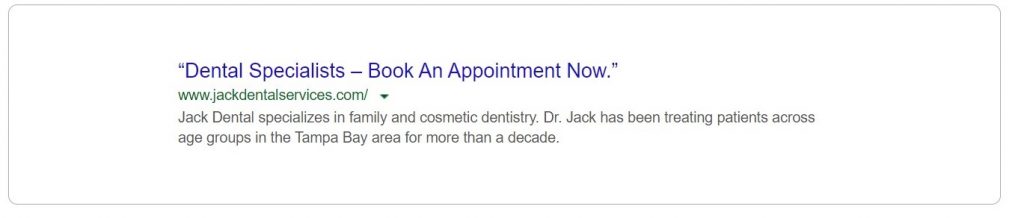
In case the title tag contains more than 50 characters, you and your patients will only see an abridged form of the same. Here’s an instance of a standard title tag: “Dental Specialists – Book An Appointment Now.”
Meta Description
Meta description offers a description of your site and captures the portal’s essence in a nutshell. Your dental website’s meta- description appears as an extract or a citation in search engines’ SERPs. Ensure that your site’s meta-description does not contain more than 160 characters.
Example: Jack Dental specializes in family and cosmetic dentistry. Dr. Jack has been treating patients across age groups in the Tampa Bay area for more than a decade.
Inserting internal links
Internal links are URLs listed in a webpage or blog that enable you to land on related sites. Inserting internal links can help improve your site’s visibility as well as bolster your dental SEO.
Example: For key technical terms like “Implants”, “Root Canal”, “benefits to replacing missing teeth with dental implants” or other similar terms on different pages link to dedicated pages for such terms. These pages need to elaborate further about those key phrases and ensure a patient is aware of what they mean or stand for. Additionally, ensure you are interlinking relevant pages to improve the accessibility of your website.
Alt text for illustrations and images
The bot crawlers of search engines perceive the images, illustrations, and representations across the internet as space. Therefore, captioning the different images and pictures in your site with alt-text or alternative text augments online visibility as well as makes your site more user-friendly for visually challenged individuals.
Example: When using an image for Root Canal, you should ensure you are using related keywords both as the image title and alt text. For this case, you can use the image title as “Root Canal” while the alt text could be “Root Canal Treatment.”
Off-page SEO for Dentists
Off-page has to do with how your dentist marketing site interacts and networks with competitor sites (and all other sites). The tools and techniques of off-page SEO can also go a long way in directing a greater flow of traffic towards your site.
Citations
Citation implies online indexing of information concerning your dental practice. Ensuring NAP (name, address, and phone number of your practice) consistency across all local listings in SEO helps reinforce your SEO ranking. In case you’ve recently changed your contact number or relocated make sure you update these changes on all local listings.
Inconsistency in NAP citations will hurt your site’s ranking across search engines.
Example: List your business on different online directories such as Google MyPlaces, Bing Places, Yelp, etc. However, when listing on such a website, make sure that you are consistent with the information you provide. The name, address, contact numbers, and other important information should be the same on all such portals.
Guest Blogging
Look for reputed dental sites that invite guest posts. You’ll have a good chance of reaching out to a greater number of potential patients via your guest posts on popular blogs.
Example: Post informative articles related to your services on websites offering information for dental services and treatments. Getting featured on popular websites such as https://www.aaid.com/, https://www.dentistfriend.com/, etc. with a backlink to your website can boost your credibility as well as rankings.
Backlinks
Sites that help connect back to your website are known as backlinks. You should aim for having as many backlinks as possible that’ll enable you to improve your site’s standing. Make the most of backlink auditing tools such as SEMRush and SpyGlass for obtaining the maximum number of backlinks.
Example: You may scan your competitors using such tools and note down portals where they are getting backlinks from. You may then make a complete list of potential websites where you can feature content related to your industry and get backlinks for.
Implement Local SEO for Dentists
Optimizing your dental practice website for local SEO helps your website to invariably show up on the first SERPs of different search engines. Most informational and promotional blogs, portals, and websites featuring on Google or Yahoo are meant for global or national netizens. However, websites dedicated to the treatment, medication, and healthcare are designed and developed basically to optimize for local SEO searches.
Your dental SEO strategy should focus on particular territories and regions so that your prospects can track you easily and quickly. Just add the name of your city or town and also the names of towns and cities in your vicinity. At the same time, ensure that you have added the locations to your URLs and page titles.
For example, if you are providing dental treatments in New York, You should optimize for keywords like “Dental Implants in New York”, “Dental Treatments in New York”, “Dentists in New York”, “New York City Dentists”, etc.
Additionally, make sure you’ve signed up with Google My Business and Google Maps, and other local SEO providers to shore up your web presence.
Google Maps Optimization
Once you’re done planning and implementing your SEO strategy, working towards achieving a better ranking in Google Maps might seem superfluous. However, ignoring the significance of Google Maps rankings could prove disastrous. Are you aware that prospective clients can contact a dental practice directly after clicking on the Maps results via Google snack pack without logging in at the website?
So, if you’re not listed on Google Maps you’ll miss out a big portion of patients looking for dental services. To get better results from local seo for dentists start with Google Maps optmization and then enhance your authority on Maps pay heed to the following simple steps:
List NAP Citations (Name, Address, and Phone Number)
Register your practice with Google My Business
Get as many quality backlinks as possible
Incorporate location details and local SEO keywords in your website
Request your patients to submit positive reviews and feedbacks about your practice (Reviews on Google My Business, Bing Places, Yelp, etc.)
Example: The above example displays the details of Google My Places for British Implant and Oral Surgery in New York. They are dentists in New York and you will be able to see how well their website is optimized for results and reviews featured on Google. It provides details about their clinic and other essential information at a single place. If you are able to get reviews from your clients published on Google and you provide consistent NAM on different directories on the internet, you can achieve the same for your website.
Paid Advertisement for Dentists
Google Ads
Google Ads or Google AdWords come to your aid if your portal has been relegated to the 2nd or 3rd page of search engine results. You’ll see Google Ads emblazoned on the blank panel right above the organic SERPs. You have full leeway in selecting the ad specifics as well as in setting your budget.
Example: Use the Keyword Planner tool on Adwords to look for keywords related to your services. Your focus should be to shortlist keywords for Local SEO to improve the prospect of conversion. Your target area should be restricted to your service coverage area. Examples include, “Dentists in New York”, “Dental Implants in Tampa Bay”, “Affordable Dental Implants”, etc.
Retargeting Ads
The display, retargeting, and remarketing ads of Google serve to ring a bell to your patients about your dental practice. Google retargeting ads usually target potential patients who’re acquainted with your practice but somehow did not take the bait. You can add more teeth to your remarketing ads by:
Limiting the frequency of your display ad
Deciding on the duration your target audience will be able to view the ad
Tempering your retargeting ads with pictures and illustrations
Focusing your dental marketing/retargeting efforts on a specific demographic (such as a particular age- or ethnic group)
Businesses are always looking for different ideas for capturing their audience’s attention. They are torn between choosing the tested and true traditional marketing strategies and the advanced ingenious digital marketing strategies with each of one having their own plus and minus.
Today digital marketing both organic and advertising space is on big boom. Internet marketing has proven with thousands of business models with great ROI numbers. However, there are several marketing situations where traditional direct mail marketing is more effective than online marketing
Conventional marketing is opposite of digital marketing and both have their strengths, but which one is the most powerful?
According to statistics, fifty-two percent of companies use a minimum of seven channels to engage with their customers and audience. Though digital marketing continues to expand and enjoy the budget’s lion share, traditional marketing mediums carry on many business types.
There are many things to think about when talking about digital marketing -vs.- traditional marketing.
When talking about traditional marketing vs. digital marketing, there is a lot to consider. This blog post will briefly discuss the purpose of each strategy, its benefits, along with its pros and cons to help you determine which approach is an excellent fit for your business.
What is Traditional Marketing?
Traditional marketing has several aspects. It includes every marketing method that you can do without using the internet. Conventional marketing has been around for several decades and still in use today though less often.
Traditional marketing Strategies include:
Print advertisement in newspaper or magazines
Business cards
Billboards
Brochures
Posters
Commercials on TV or radios
Window signs and displays
Traditional marketing plays a critical role in helping you reach your local audience. You can keep the ads for as long as you want to. Also, you’ll always find that there’s an audience that’s way much easier to reach using traditional methods than digital marketing.
Every effort to promote your business without using the internet is traditional marketing.
Though traditional marketing has evolved with time, the fundamentals remain the same.
You hear and see these ads almost daily, whether you are listening to the radio, watching TV, or seeing the billboards on your way to work as you pass by. They are part and parcel of our everyday life.
What is Digital Marketing?
Digital marketing refers to every marketing campaign that a company does online.
Digital marketing has grown exponentially due to changes in society, technology, and culture.
These digital marketing strategies have become very popular nowadays as consumers use mobile appliances and the internet frequently.
There are 4. 64 billion active web users globally and 3.7 billion active social media users, according to Statista. You see. It makes sense to market your products online because you’ll be able to reach a bigger audience.
Traditional Marketing vs. Digital Marketing – What Is The Difference?
The only significant difference between digital marketing and traditional marketing is how the target audience comes across the intended message.
Traditional marketing focuses on passing the message using tangible items such as calendars, newspapers, billboards, etc., while digital marketing centers on using digital media such as social media platforms, websites, etc.
Advantages of Traditional Marketing Over Digital Marketing
Traditional marketing is still an effective advertising method as it’s tried and tested and has been in use for a couple of decades.
It focuses primarily on product promotion and brand recognition on a big scale. Traditional marketing may be costly, but it has several advantages such as;
Easily accessible
Longevity- the audience can see your ad for a long time.
Radio and TV commercials play several times a day, reminding the target audience of the existence of your business. And the viewers have no choice but to brave them even if they do not like them. On the other hand, in digital marketing, the audience has more choice regarding the advert. Audiences can block the ads by clicking ” I do not want to see this ad” on social media platforms. They can skip through ads before Youtube videos begin to play.
Traditional marketing can be highly effective if you need to reach an older population. According to GlobeNewswire, viewers aged fifty years and above spend at least twice of their free time watching TV and reading newspapers in comparison to those aged between 20- 36 years.
For every business looking to build a more prominent local audience, a traditional marketing strategy can be ideal. Startups are far more successful in competing for attention using fliers, brochures, and billboards instead of competing for online space against more prominent brands.
Accessibility may be the most significant aspect of traditional marketing. Televisions, radios, newspapers, and other entertainment media that rely on advertisements are accessible to almost everybody on the planet.
Almost everybody on the globe has unlimited access to newspapers, TVs, radios, and any other type of entertainment that depends on the advertisement. So, if you place your ads on some of these items, you can be sure that they’ll reach the target audience.
In the Us alone, 99 percent of all households have a TV. In just one nation, 315 million people have access to broadcast ads.
Disadvantages of Traditional Marketing Strategy
Reaches only the local audience
In some cases, you can’t measure the results
Costly compared to digital marketing
Advantages of Digital Marketing
Due to technological advancement, digital marketing strategies will keep evolving. Here are the advantages of using digital technology to grow your brand awareness.
You are to reach both local and global audiences at the same time.
It’s less costly compared to traditional marketing
Results are easier to measure
You can customize your marketing campaigns to a specific audience
it is easy to engage with your audience
It’s two-way communication- you hear from the audience and respond to each other.
You can quickly track information and audience engagement. When somebody reads an email, clicks on a link to your website, or starts following you on social media, you get that data instantly. You can gather insights from this reliable data. From there, you can determine which platforms are most suitable for you. You’ll also be able to tell what time and which days are eligible to engage your audience.
Disadvantages of Digital Marketing
Due to changes in technology, you have to keep evaluating and reevaluating things as what works perfectly today may be useless tomorrow.
Internet users can block ads so that they never get to see banner adverts or pop-ups. Other web users can skip ads or have the ads removed if they pay for premium services such as Twitch, Hulu, and Spotify.
So, When Comparing Traditional Marketing vs Digital Marketing, Which one is better then the other?
The answer is it depends on your target audience and the type of business you conduct.
However, digital marketing could be a superb option. It enables you to reach a massive number of people regardless of their location on the globe while cutting down the cost. Also, you receive first-hand information from your following so that you can tailor your content based on their needs. You can easily interact with your target audience via surveys, webinars, and videos.
Nonetheless, traditional marketing still has a solid place in the marketing world. Traditional marketing is memorable, impactful, and can last forever. It’s still effective as it was back then, especially if you are targeting pensioners.
When thinking about which marketing strategy is appropriate for your business, determine who your target audience is based on the products and services you offer. If you know who you are targeting and what you are selling, you’ll know the best way to build your brand awareness.
Can Traditional Marketing and Digital Marketing work together?
Though traditional marketing and digital marketing are different, they do not have to be sworn enemies. You can combine them to steer your business to a whole new level.
To see an excellent combination of traditional and marketing videos, consider Guinness. Their TV commercials are legendary due to their eccentric cinematography. Twenty-two years down the line, Guinness’s finest 1999 ‘Surfer’ campaign remains the all-time best TV commercials.
Nonetheless, even with its world-class status, Guinness has to keep up with the trends and integrate digital marketing in its campaign to avoid missing out on enormous marketing opportunities. Here’s the link to their excellent ad
What are KPIs in Marketing?
KPI stands for Key Performance Indicators. It is a quantifiable value that shows the progress you are making towards achieving a business objective. A KPI in marketing is a computable value attached to the unique goals of a marketing campaign. It stipulates progress throughout a campaign and assists in measuring marketing success at the end of every campaign.
The five Key Performance Indicators that you can easily track are;
Average Class Attendance (ACA)
Client Retention Rate (CRR)
Profit Margin (PM)
Revenue per client/member (RPC)
Average Daily Attendance (ADA)
Closing Thoughts
The baby boomer generation (people born between 1945- 1964) welcomes traditional marketing channels. Some love watching TV, listening to the radio, and still buying newspapers and magazines. On the other hand, digital marketing cuts across all age groups. You’ll find people in their seventies on Facebook posting photos of their families and great-grandkids.
The bottom line is that both traditional marketing and digital marketing are effective. Just be sure to know what your audience needs.